
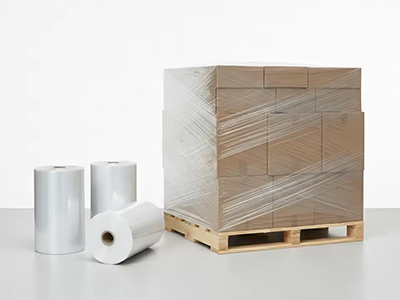
Cast stretch film and blown stretch film are the two main types of stretch wrap used to secure palletized loads. They are both made from polyethylene, usually linear low-density polyethylene or LLDPE, but they are produced by different processes that give each type distinct strengths. Understanding the difference helps you choose the right film for your loads and reduce packaging cost.
Cast stretch film is made by feeding molten resin through a flat die onto a chilled roller, where it cools quickly.
This process produces a film that is highly transparent, easy to unwind quietly, and very consistent in thickness. Cast film also releases smoothly from the roll, which makes it comfortable for operators using hand dispensers. Its main limitation is that it has lower tear and puncture resistance than blown film, so it is best suited to light and uniform loads without sharp edges.
Blown stretch film is made by extruding molten resin through a circular die and inflating it with air into a bubble, which is then collapsed into a flat film. This process gives blown film higher tear and puncture resistance and a stronger ability to return to its original shape after stretching, a property often called memory. Blown film is usually slightly hazier and noisier when unwinding than cast film, but it holds tighter on sharp, heavy, or irregular loads and performs better in cold conditions.
The choice between the two comes down to the load. For smooth, light, uniform loads where speed and clarity matter, cast film is usually the better and more economical option. For heavy, sharp, or irregular loads that demand extra strength, blown film provides more protection. Many operations keep both types on hand so they can match the film to the job rather than overpaying for strength they do not need or risking damage with a film that is too light.
Film gauge and pre-stretch settings matter in both types. Thinner films cover more surface area per roll and cost less per pallet, while thicker films resist damage on demanding loads. Machine wrappers that pre-stretch the film to between 200 and 300 percent also stretch the film before it touches the load, reducing material use while maintaining holding force.
Shanghai Pudi Packaging manufactures both cast and blown stretch film in a wide range of gauges, widths, and colors, with an annual production capacity of 12,000 tons. The company sources from leading raw-material suppliers and holds certifications including ISO 9001 and GRS 4.0. For distributors and brand owners, Pudi offers OEM and custom-printed stretch film to match specific load requirements. If you are unsure which type is right for your operation, sharing your typical load weight, shape, and wrapping method with the factory is the fastest way to get a precise recommendation.