
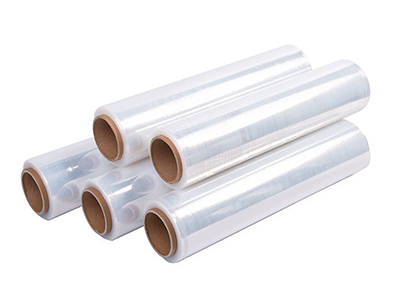
Hand stretch film and machine stretch film serve the same purpose of securing palletized loads, but they are designed for very different application methods. Choosing between them depends on your volume, the weight and shape of your loads, and your labor costs. Understanding the difference helps you avoid overspending on film or under-protecting your goods.
Hand stretch film is applied manually, usually with a simple hand dispenser or a handheld film handle. It is narrower, typically around 12 to 20 inches wide, and comes in lighter rolls that an operator can carry. Hand film is convenient for low-volume operations, irregular loads, and touch-up wrapping, because it requires no equipment investment. The trade-off is that hand application provides less consistent tension and uses more film per pallet, and it is slower and more labor-intensive when wrapping many loads each day.
Machine stretch film is applied by a stretch wrapping machine, which rotates the load and applies the film with controlled, even tension. It is wider, typically around 20 to 30 inches, and is designed to be pre-stretched by the machine, commonly to between 200 and 300 percent before it reaches the load. This pre-stretching makes the film thinner and wider on the pallet, so machine wrapping uses significantly less film per load and applies more consistent holding force. The trade-off is the upfront cost of the wrapping machine.
The decision usually comes down to volume.
For a few pallets per day, hand film is often the more practical and lower-cost choice. For operations wrapping many pallets per day, machine film usually pays for itself through lower film consumption, faster wrapping, and more reliable load stability, even after accounting for the machine investment.
Film gauge also plays a role. Both hand and machine film come in different thicknesses, commonly measured in gauge. Lower-gauge films suit light, uniform loads, while higher-gauge films resist punctures and hold tighter on heavy or sharp loads. Machine film is typically available in a wider range of pre-stretch-optimized gauges, while hand film is chosen for easy manual handling.
Shanghai Pudi Packaging manufactures both hand and machine stretch film in a wide range of gauges, widths, and colors, with an annual production capacity of 12,000 tons. The company holds certifications including ISO 9001 and GRS 4.0 and offers OEM and custom-printed stretch film for distributors and brand owners. If you are not sure whether hand or machine film is right for your operation, sharing your daily pallet volume, load type, and equipment with the factory is the fastest way to get a recommendation that balances film cost and load protection.